File:Navier Stokes Laminar.svg
跳转到导航
跳转到搜索

此SVG文件的PNG预览的大小:750 × 600像素。 其他分辨率:300 × 240像素 | 600 × 480像素 | 960 × 768像素 | 1,280 × 1,024像素 | 2,560 × 2,048像素 | 900 × 720像素。
原始文件 (SVG文件,尺寸为900 × 720像素,文件大小:9.37 MB)
摘要
| 描述 |
English: SVG illustration of the classic Navier-Stokes obstructed duct problem, which is stated as follows. There is air flowing in the 2-dimensional rectangular duct. In the middle of the duct, there is a point obstructing the flow. We may leverage Navier-Stokes equation to simulate the air velocity at each point within the duct. This plot gives the air velocity component of the direction along the duct. One may refer to [1], in which Eq. (3) is a little simplified version compared with ours. |
| 日期 | |
| 来源 |
自己的作品
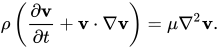
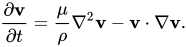
The following code leverages some numerical methods to simulate the solution of the 2-dimensional Navier-Stokes equation. We choose the simplified incompressible flow Navier-Stokes Equation as follows: The iterations here are based on the velocity change rate, which is given by Or in X coordinates: |
| 作者 | IkamusumeFan |
| 其他版本 |
  |
| SVG开发 |  本图表使用Matplotlib创作。 本图表使用Matplotlib创作。 |
| 源代码 | Python codefrom __future__ import division
from numpy import arange, meshgrid, sqrt, zeros, sum
import matplotlib.pyplot as plt
from mpl_toolkits.mplot3d import Axes3D
from matplotlib.ticker import ScalarFormatter
from matplotlib import rcParams
rcParams['font.family'] = 'serif'
rcParams['font.size'] = 16
# the layout of the duct laminar
x_max = 5 # duct length
y_max = 1 # duct width
# draw the frames, including the angles and labels
ax = Axes3D(plt.figure(figsize=(10, 8)), azim=20, elev=20)
ax.set_xlabel(r"$x$", fontsize=20)
ax.set_ylabel(r"$y$", fontsize=20)
ax.zaxis.set_rotate_label(False)
ax.set_zlabel(r"$v_x$", fontsize=20, rotation='horizontal')
formatter = ScalarFormatter(useMathText=True)
formatter = ScalarFormatter()
formatter.set_scientific(True)
formatter.set_powerlimits((-2,2))
ax.w_zaxis.set_major_formatter(formatter)
ax.set_xlim([0, x_max])
ax.set_ylim([0, y_max])
# initial speed of the air
ini_v = 3e-3
mu = 1e-5
rho = 1.3
# the acceptable difference when termination
accept_diff = 1e-5
# time interval
time_delta = 1.0
# coordinate interval
delta = 1e-2;
X = arange(0, x_max + delta, delta)
Y = arange(0, y_max + delta, delta)
# number of coordinate points
x_size = len(X) - 1
y_size = len(Y) - 1
Vx = zeros((len(X), len(Y)))
Vy = zeros((len(X), len(Y)))
new_Vx = zeros((len(X), len(Y)))
new_Vy = zeros((len(X), len(Y)))
# initial conditions
Vx[1: x_size - 1, 2:y_size - 1] = ini_v
# start evolution and computation
res = 1 + accept_diff
rounds = 0
alpha = mu/(rho * delta**2)
while (res>accept_diff and rounds<100):
"""
The iterations here are based on the velocity change rate, which
is given by
\frac{\partial v}{\partial t} = \alpha\nabla^2 v - v \cdot \nabla v
with \alpha = \mu/\rho.
"""
new_Vx[2:-2, 2:-2] = Vx[2:-2, 2:-2] + time_delta*(alpha*(Vx[3:-1, 2:-2] +
Vx[2:-2, 3:-1] - 4*Vx[2:-2, 2:-2] + Vx[2:-2, 1:-3] + Vx[1:-3, 2:-2]) -
0.5/delta * (Vx[2:-2, 2:-2] * (Vx[3:-1, 2:-2] - Vx[1:-3, 2:-2]) +
Vy[2:-2, 2:-2]*(Vx[2:-2, 3:-1] - Vx[2:-2, 1:-3])))
new_Vy[2:-2, 2:-2] = Vy[2:-2, 2:-2] + time_delta*(alpha*(Vy[3:-1, 2:-2] +
Vy[2:-2, 3:-1] - 4*Vy[2:-2, 2:-2] + Vy[2:-2, 1:-3] + Vy[1:-3, 2:-2]) -
0.5/delta * (Vy[2:-2, 2:-2] * (Vy[2:-2, 3:-1] - Vy[2:-2, 3:-1]) +
Vx[2:-2, 2:-2]*(Vy[3:-1, 2:-2] - Vy[1:-3, 2:-2])))
rounds = rounds + 1
# copy the new values
Vx[2:-2, 2:-2] = new_Vx[2:-2, 2:-2]
Vy[2:-2, 2:-2] = new_Vy[2:-2, 2:-2]
# set free boundary conditions: dv_x/dx = dv_y/dx = 0.
Vx[-1, 1:-1] = Vx[-3, 1:-1]
Vx[-2, 1:-1] = Vx[-3, 1:-1]
Vy[-1, 1:-1] = Vy[-3, 1:-1]
Vy[-2, 1:-1] = Vy[-3, 1:-1]
# there exists a still object in the plane
Vx[x_size//3:x_size//1.5, y_size//2.0] = 0
Vy[x_size//3:x_size//1.5, y_size//2.0] = 0
# calculate the residual of Vx
res = (Vx[3:-1, 2:-2] + Vx[2:-2, 3:-1] -
Vx[1:-3, 2:-2] - Vx[2:-2, 1:-3])**2
res = sum(res)/(4 * delta**2 * x_size * y_size)
# prepare the plot data
Z = sqrt(Vx**2)
# refine the region boundary
Z[0, 1:-2] = Z[1, 1:-2]
Z[-2, 1:-2] = Z[-3, 1:-2]
Z[-1, 1:-2] = Z[-3, 1:-2]
Y, X = meshgrid(Y, X);
ax.plot_surface(X, Y, Z, rstride=1, cstride=1, cmap="summer", lw=0.1,
edgecolors="k")
plt.savefig("Navier_Stokes_Laminar.svg")
|



许可协议
我,本作品著作权人,特此采用以下许可协议发表本作品:


本文件采用知识共享署名-相同方式共享 4.0 国际许可协议授权。
- 您可以自由地:
- 共享 – 复制、发行并传播本作品
- 修改 – 改编作品
- 惟须遵守下列条件:
- 署名 – 您必须对作品进行署名,提供授权条款的链接,并说明是否对原始内容进行了更改。您可以用任何合理的方式来署名,但不得以任何方式表明许可人认可您或您的使用。
- 相同方式共享 – 如果您再混合、转换或者基于本作品进行创作,您必须以与原先许可协议相同或相兼容的许可协议分发您贡献的作品。
- ↑ Fan, Chien, and Bei-Tse Chao. "Unsteady, laminar, incompressible flow through rectangular ducts." Zeitschrift für angewandte Mathematik und Physik ZAMP 16, no. 3 (1965): 351-360.
文件历史
点击某个日期/时间查看对应时刻的文件。
| 日期/时间 | 缩略图 | 大小 | 用户 | 备注 | |
|---|---|---|---|---|---|
| 当前 | 2016年3月15日 (二) 02:06 | | 900 × 720(9.37 MB) | wikimediacommons>Nicoguaro | Smaller version |
文件用途
以下页面使用本文件:
